Sections
A. Octavie
B. Alf and Tassie
C. Amedee and Grace
A. Octavie
Octavie was the eldest child of Zephyrin and Claudia. She remained single and lived in the family home.
In 1878 the trio of Edouard, Claudia and Mary established the new school, the St Kilda Ladies College, in Fitzroy Street, St Kilda, where Octavie joined the staff. After the death of Edouard, Claudia, Mary and Octavie carried on the school until it was sold in 1895. They then moved to Duncraig Avenue, Malvern. As the single daughter, Octavie inherited much of the family furniture, crockery and glassware. It is believed that much was passed on to Enid (1895) and then Margot (1932). Octavie died in 1930.
B. Alf and Tassie
 Edouard (1864) was known to his parents as Alphonse and to others as Alf. He was educated at Scotch College when it wa
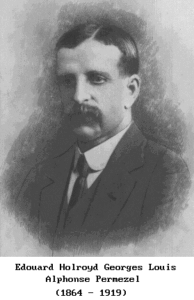 s located at the east of Melbourne, near where St Andrews Hospital is today. This would, of course, be quite near where his parents had their school in East Melbourne. After leaving school, he attended the University of Melbourne where he studied law.
As a young man he was very active and, in his mother’s eyes, quite daring, and she, at least on one occasion, found it necessary to admonish him on this account. He liked sport and, at one time during the 1890’s, he played for the St. Kilda Football Club (1) – although the club does not currently recognise this.
By 1990 he had established himself as a solicitor with a practice at 99 Queens Street in the name of Hughes and Permezel. Whether Hughes was in the practice in the early days is not known but Alf certainly was the principal in later years. His law practice was not confined to Melbourne and he regularly visited the country where his firm is known to have had branches in Romsey and as far afield as Bright. There exists a photograph (2) taken on market day in Romsey in 1910 of a group of men outside the hotel and Alf is among them. The practice acted for a number of hotels, which represented a sizeable proportion. The practice was later to move to 491 Chancery 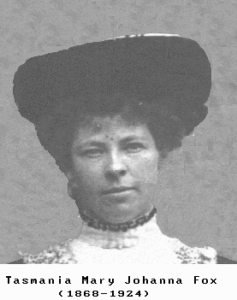 Lane (now Little Collins Street).
Alf married Tasmania Mary Johanna Fox (1868), the daughter of Mary Emily McPherson (1839) and William Fox (1830).
Mary was the daughter of Captain Daniel James McPherson (1805) and Frances Anne Boore (1812). Daniel 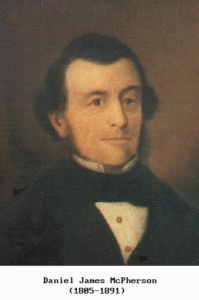 McPherson was born in London and is believed to be the son of a Royal Naval Officer. It has been claimed that his father, also Daniel, served on Admiral Nelson’s flagship, the `Victory’, under Captain Hardy at Trafalgar (3) but there is no Daniel McPherson listed as serving in Battle of Trafalgar. Daniel went to sea at an early age and captained a number of ships before settling in Australia in the beginning of the 1840’s. His wife Frances followed him arriving in December 1842 with their family of three
 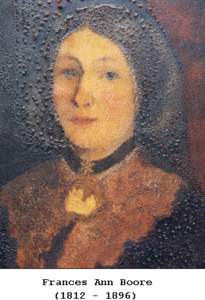 girls of whom Mary was the youngest. By 1845, they were living in Williamstown and Daniel was a pilot. Later he was to be asked by Governor La Trobe to be the Harbour Master for the Port of Geelong and he took up the appointment in 1856 and remained there until 1865. Daniel’s wife Frances came from Sutton Benger, Wiltshire, and her father Richard Boore is quite a mystery man for, apart from his listing as her father, and that of her siblings, there is no other record at all.
William Fox married Mary McPherson in Geelong at All Saints Church on 9 February 1864. William was born in Salzpittern (4), which is near Hannover, West Germany. His original German name was Georg Frederich Christian Wilhelm Fuchs and was the son of Georg Fuchs and Johanna Schaefer. His father was the Master of the salt works, presumably at Salzpittern. When and why William came to Australia is not known but it could have been as a result of the Berlin uprisings, which caused many Germans to migrate. Anyway by 1864 he had anglicised his name to Fox and described himself as a merchant.
Tassie was born at `Liebenhalle’, Robe Street, St. Kilda on 1 October 1868 and lived there until she married Alf on 26 August 1891. Robe Street intersects with Acland Street where the Permezel school was located after 1878. Tassie was one of the early pupils at the Presbyterian Ladies College but she may have attended the Permezel school beforehand. In any case, the two families would have known each other as near neighbours.
At the time of their marriage, Alf settled in trust for Tassie the sum of 1000 pounds (5). The trustees were Tassie’s two brothers: Melbourne, then a law student, and Sydney, a clerk. Melbourne was later to join Hughes and Permezel as a solicitor and, after the death of Alf, to purchase the firm.
Their first home was in Durham Street, Hawthorn but before the end of the century, they moved to “Voreppe”, Jessie Street (now Forster Avenue), East Malvern, which would remain the family home until Alf’s death in 1919.
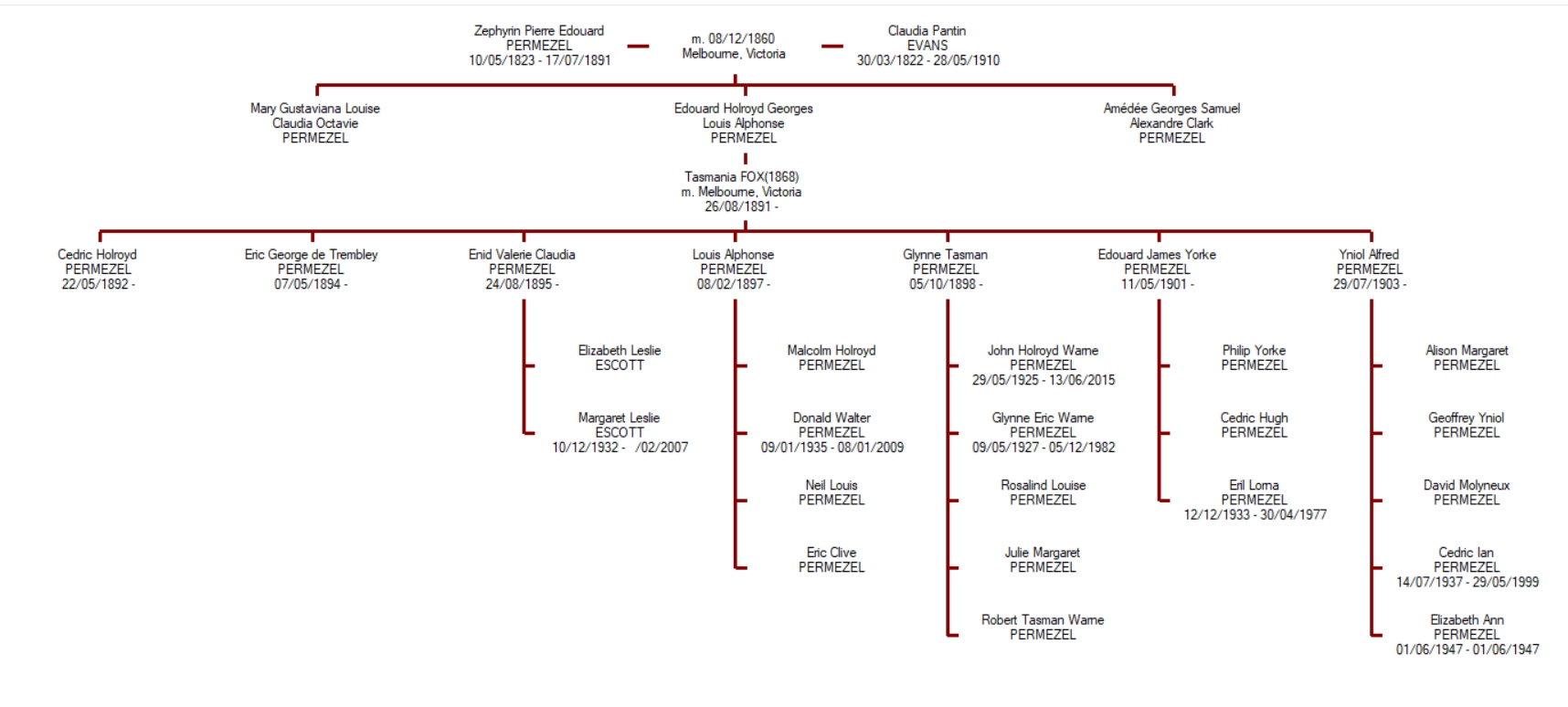
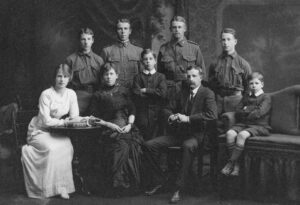
Alf and Tassie had seven children – Cedric (1892), Eric (1894), Enid (1895), Louis (1897), Glynne (1898), Edouard (1901) a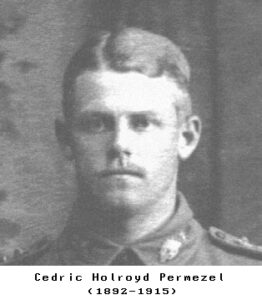 nd Yniol (1903). The eldest, Cedric, was fatally wounded at Gallipoli in 1915.
Alf was devastated by the death of his eldest son and threw himself into the war effort, particularly in helping those who had suffered losses like his own. He did this at the expense of his legal practice, which suffered as a result. Consequently, when he died there was little provision for Tassie and the other boys had to rally round and help to support their mother.
The legal practice was sold to Tassie’s two brothers, Sydney and Melbourne Fox, but it was many years before the full proceeds of the sale were recovered. It became the responsibility of Alf’s son Glynne (1898), himself a law student, to act on behalf of his mother in the negotiations with his uncles. Final settlement of the sale did not occur until after the death of Tassie in 1924.
The other sons also started school at Malvern Grammar School, which was then located in Coppin Street, East Malvern. However, after a few years at Malvern they completed their education at Wesley College in Punt Road, Prahran. In the early 1900’s an electric tram started operating from the corner of Burke and Wattletree Roads, East Malvern and went to the St Kilda Junction. It was a short walk up Punt Road to Wesley. This apparently was considered to be more convenient than travelling to the city on the steam train fro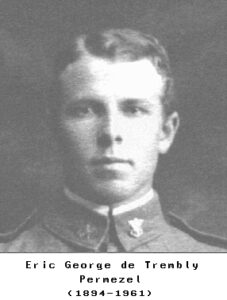 m Darling Station. The boys rode a horse from Jessie Street to the tram terminus.
The second son, Eric (1894), enlisted in November 1914 and rose to the rank of Captain in the 5th Battalion. He received the Military Cross (6) for his actions at St Martin Wood on 23 August 1918.
Louis (1897) also tried to enlist but was rejected on medical grounds. Alf and Tassie’s only other son of military age, Glynne (1898) did enlist and was sent to France as a gunner reinforcement for the 103rd Howitzer Battery. However, by the time he was due to go to the front line, the war was over. On the way to the front, Glynne heard Eric’s voice in the dark – Eric was on his way back and was going home to Australia (7). Family legend is that it was Eric’s laugh that Glynne heard – apparently a very characteristic laugh that could not have come from anyone else!
—–ooooo—–
Footnotes – Alf and Tassie
(1) Edouard Yorke (1901) told John (1925) that Alf captained the club but this has not been substantiated.
(2) Melbourne `AGE’ 12 April 1980. Alf is the 5th from the left in a black hat.
(3) Letter from Anna Quinton to Alice Moggs of unknown date.
(4) Shown on marriage certificate.
(5) Settlement date 24 August 1891.
(6) Eric’s Military Cross is in the possession of Malcolm(1933).
(7) See Appendix 21
C. Amédée and Grace
[by Paul Permezel(1925)]
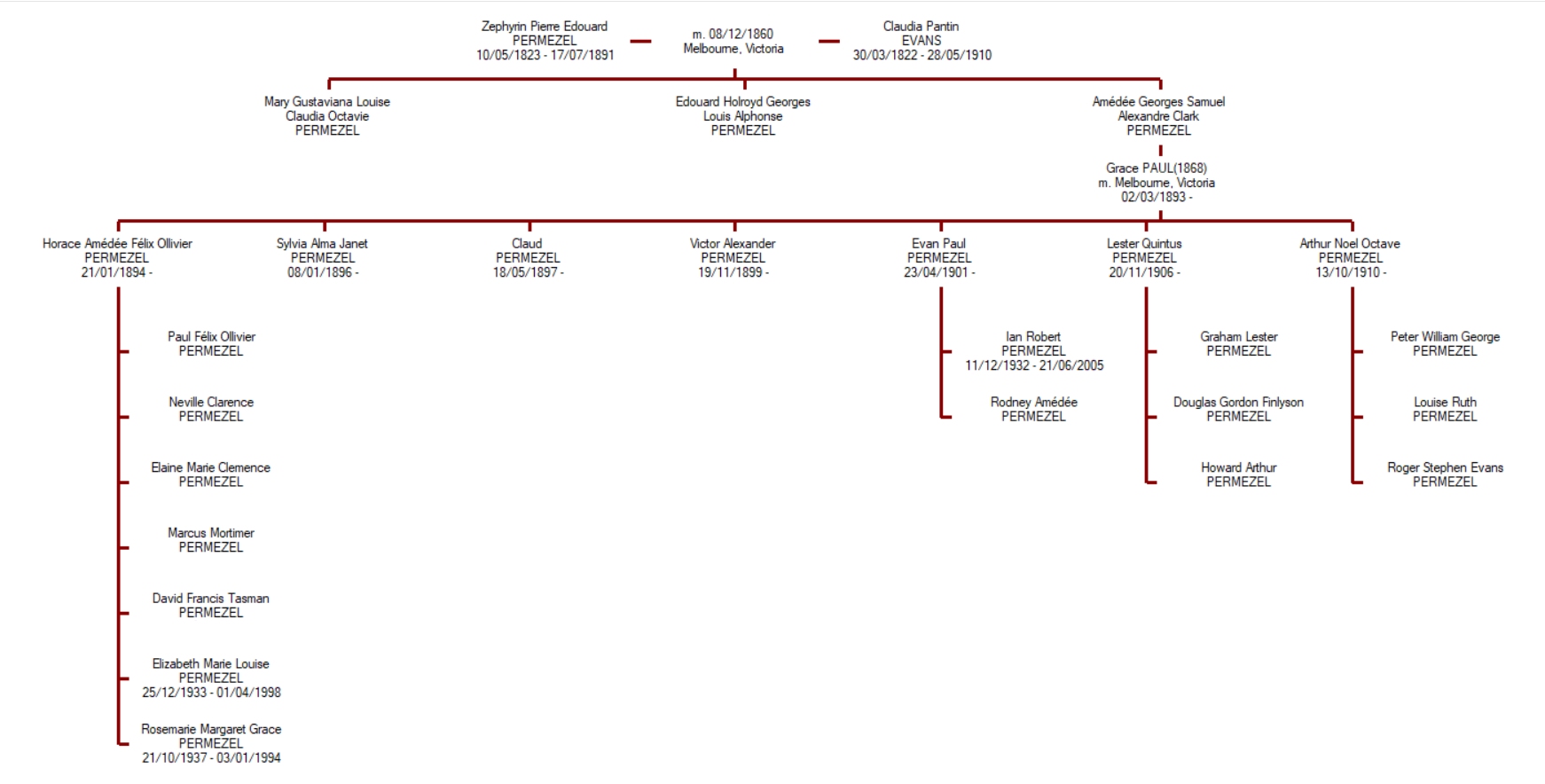 Amédée Georges Samuel Alexandre Clark Permezel was born at East Melbourne on 31-12-1866. He was the youngest of the three children of Edouard Permezel and his wife Claudia (née Evans). The other two children were Mary Gustaviana Louise Claudia Octavie (1863-1930), and Edouard Holroyd Georges Louis Alphonse (1864-1919).
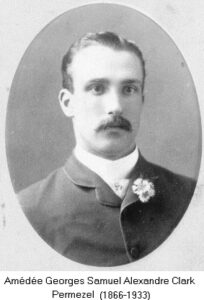 Amédée Permezel passed his final examination for a Bachelor of Law degree at Melbourne University in November 1892 in the company of five other male candidates.
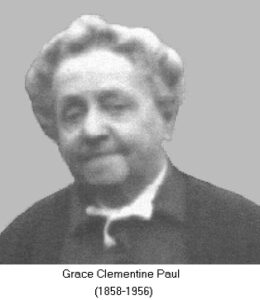
In 1893 Amédée married Grace Clementine Paul, who with her twin brother John Colin, was born at St. Kilda in 1868. Grace Clementine’s father, the Reverend Arthur Paul, arrived in New South Wales in November 1853 from Scotland. He came to Melbourne in November 1854, and married Janet Brown Moffat in 1859. All their twelve children were born at the Manse of the Free Presbyterian Church in Alma Road St. Kilda. Arthur Paul died at the age of 84 at the Manse in 1910 after having served as the minister of the Free Presbyterian Church, St. Kilda for 55 years.
Amédée practised law in Melbourne, Bacchus Marsh, and Yarrawonga.
 Seven children were born to Amédée and Grace Permezel. Two children died at an early age (212, 6mths). The five surviving children were: Horace Amédée Ollivier (1894-1969), Sylvia Alma Janet (1896-1982), Evan Paul (1901-1973), Lester Quintus (1906-1967) and Arthur Noel Octave (1910-1962). Horace was born at St. Kilda – Sylvia, Lester and Evan Paul were born at Bacchus Marsh; and Arthur was born at Yarrawonga.
Amédée moved with his family from Bacchus Marsh to Yarrawonga in 1907. Although Amédée was a commendable student at Wesley(1883), and subsequently completed an articled clerkship rising to a law degree at Melbourne University (1892), his law practices were not particularly remunerative. His five children were largely educated at state schools, although Horace had a 2-year stint at a small private school at Yarrawonga (Alexandra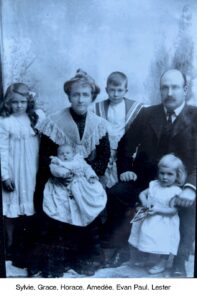
College?), and Arthur attended All Saints Grammar School in St.Kilda. Lester obtained a Bachelor of Law degree at Melbourne University. Horace studied banking and accountancy by correspondence via Hemingway & Robertson.
At this writing, there is no record of when Amédée and family moved back to Melbourne, although from family photographs and letters, it is known that the family still resided at Yarrawonga in 1916.
Horace was keenly aware of his eligibility for war service during the First World War. His cousin Cedric (1892-1915) and uncle Lester Laurie Paul (1881-1957) served in the AIF; Cedric died at Gallipoli. Horace was rejected at three separate attempts to enlist because of a foot deformity. Horace successfully applied to the Commercial Bank of Australia Ltd in 1909 for a position as a bank clerk. He had positions as a junior clerk, ledger keeper, and teller in CBA branches at St.Kilda and Williamstown, then as a clerical assistant to the general manager at head office, 333 Collins St. Melbourne.
Around 1920, Horace was posted to his first position as a branch manager to Heywood, Vic. It was here that he met Ivy Rosina Ainsworth (1894-1975), a school teacher whom he married in 1922, by which time he had been transferred to manage the CBA branch at Jeparit, Victoria. (Robert Gordon Menzies was born at the back of his father’s general store in Jeparit in December 1894.)
Four of the seven children born to Horace and Ivy Permezel were born at Jeparit: Paul Felix Ollivier 20-02-1925, Neville Clarence 04-04-1926, Elaine Marie Clemence 25-02-1928 and Marcus Mortimer 24-06-1929. In June 1930, Horace was transferred to manage the CBA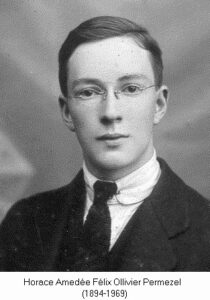 branch at Scottsdale, Tasmania. It was here that the remaining three children were born: David Francis Tasman 24-05-1932, Elizabeth Marie Louise (25/12/1933 – 01/04/1998) and Rosemarie Margaret Grace (21/10/1937 – 03/01/1994).
In January 1940, Horace was transferred to manage the CBA branch at Queenstown, Tasmania at which time the Mount Lyell Mining & Railway Co. Ltd was moving into its peak production period as Australia’s top producer of refined copper for industrial goods and munitions for the war effort.
Horace’s last and final posting was to Brighton (Adelaide) South Australia. in 1950, by which time Paul, Neville and David had already left home for the mainland. Soon afterwards, Marcus moved to Melbourne to continue and complete his civil engineering studies. Elaine, and Elizabeth while essentially still based at home in Adelaide, worked with ANA, and TAA respectively, as air hostesses; and then after various positions in South Australia both married and settled in Adelaide. Rosemarie finished her secondary education in Adelaide, trained as a kindergarten teacher, obtained her Bachelor of Arts (Hons), and at the time of her death had been managing a computer system while teaching at a secondary school in Canberra. She left behind her husband and two children.
In the mid 1950s, Ivy lowered her age by ten years and obtained a clerical position at Chrysler Australia and later joined the South Australian education department as a primary teacher at Brighton, where she taught for about two years.
Horace retired from the CBA in January 1959 with regret because he had wanted to complete a full fifty years’ service which would have required another three months’ work, an extension to which head office would not agree. During his retirement, Horace visited David who worked for the Australian administration it Papua New Guinea. On his second visit, when David was district commissioner based at Mount Hagen, Horace ruptured an aortic aneurysm from which he died on 21-6-1969. He was buried at Port Moresby.
Neville was the first to leave home at Queenstown (1946) to work as an assayer at a scheelite mine on King Island. He then worked his way around Australia to settle in Perth where he did extensive postgraduate studies in biological sciences which he furthered at London, Ontario in biochemistry to obtain his M.Sc. Neville now lives at Wollongong, NSW.
Paul left Queenstown in 1948 to work on the commercial and general management side of engineering enterprises in Melbourne, in Brisbane 1970-76, and in the Pacific & Far East (based in Melbourne) 1977-86. From 1987-99 Paul ran his own engineering business located at Braeside, Victoria.
Marcus worked as a civil engineer in Melbourne on major construction contracts, In the mid 1960s moved back to Adelaide, eventually joining the South Australian Public Works Department to design and supervise government contracts.